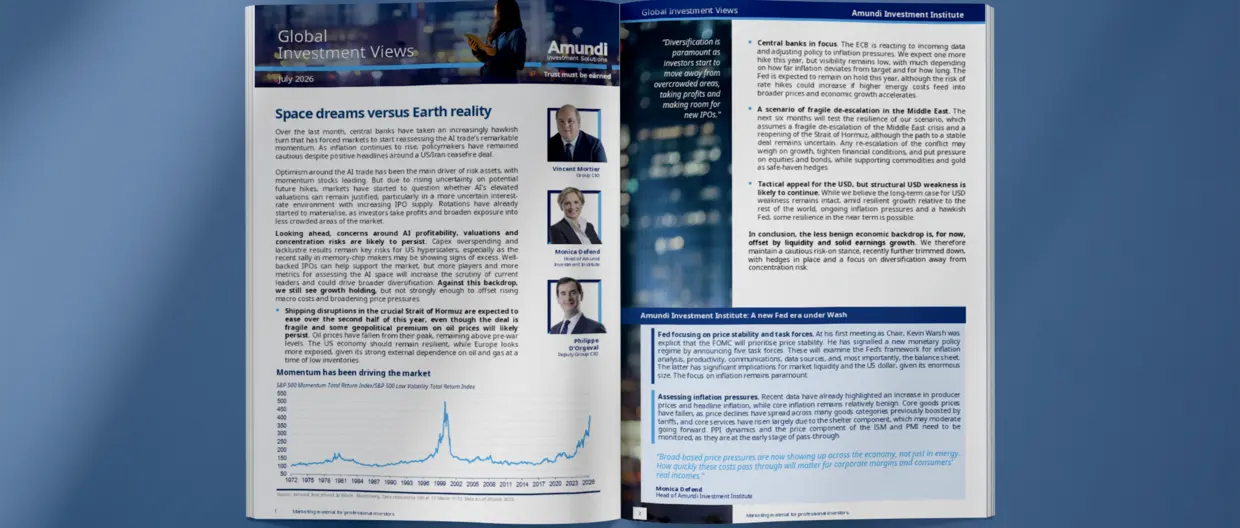
Space dreams versus Earth reality
Over the last month, central banks have taken an increasingly hawkish turn that has forced markets to start reassessing the AI trade’s remarkable momentum. As inflation continues to rise, policymakers have remained cautious despite positive headlines around a US/Iran ceasefire deal.
Optimism around the AI trade has been the main driver of risk assets, with momentum stocks leading. But due to rising uncertainty on potential future hikes, markets have started to question whether AI’s elevated valuations can remain justified, particularly in a more uncertain interest-rate environment with increasing IPO supply. Rotations have already started to materialise, as investors take profits and broaden exposure into less crowded areas of the market.
Looking ahead, concerns around AI profitability, valuations and concentration risks are likely to persist. Capex overspending and lacklustre results remain key risks for US hyperscalers, especially as the recent rally in memory-chip makers may be showing signs of excess. Well-backed IPOs can help support the market, but more players and more metrics for assessing the AI space will increase the scrutiny of current leaders and could drive broader diversification. Against this backdrop, we still see growth holding, but not strongly enough to offset rising macro costs and broadening price pressures.
Our main convictions are outlined below:
• Shipping disruptions in the crucial Strait of Hormuz are expected to ease over the second half of this year, even though the deal is fragile and some geopolitical premium on oil prices will likely persist.
• Central banks in focus. The ECB is reacting to incoming data and adjusting policy to inflation pressures. We expect one more hike this year, but visibility remains low, with much depending on how far inflation deviates from target and for how long.
• A scenario of fragile de-escalation in the Middle East. The next six months will test the resilience of our scenario, which assumes a fragile de-escalation of the Middle East crisis and a reopening of the Strait of Hormuz, although the path to a stable deal remains uncertain.
• Tactical appeal for the USD, but structural USD weakness is likely to continue. While we believe the long-term case for USD weakness remains intact, amid resilient growth relative to the rest of the world, ongoing inflation pressures and a hawkish Fed, some resilience in the near term is possible.
Continue reading the full document
Unless otherwise stated, all information contained in this document is from Amundi Asset Management S.A.S. and is as of 2 July 2026. Diversification does not guarantee a profit or protect against a loss. The views expressed regarding market and economic trends are those of the author and not necessarily Amundi Asset Management S.A.S. and are subject to change at any time based on market and other conditions, and there can be no assurance that countries, markets or sectors will perform as expected. These views should not be relied upon as investment advice, a security recommendation, or as an indication of trading for any Amundi product. This material does not constitute an offer or solicitation to buy or sell any security, fund units or services. Investment involves risks, including market, political, liquidity and currency risks. Past performance is not a guarantee or indicative of future results.
Date of first use: 2 July 2026
Doc ID: 5700905