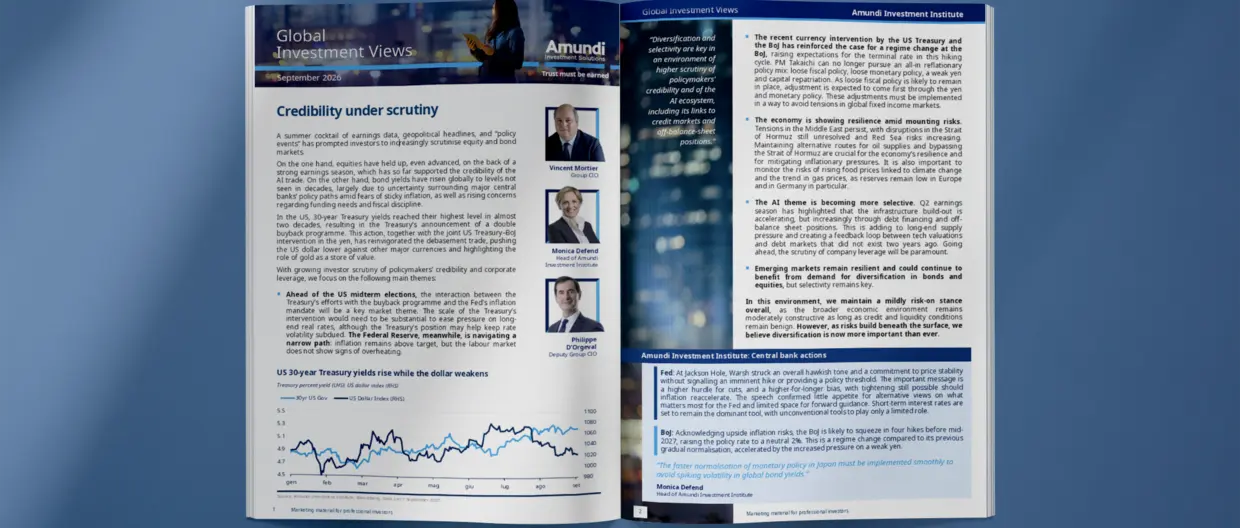
Credibility under scrutiny
A summer cocktail of earnings data, geopolitical headlines, and “policy events” has prompted investors to increasingly scrutinise equity and bond markets.
On the one hand, equities have held up, even advanced, on the back of a strong earnings season, which has so far supported the credibility of the AI trade. On the other hand, bond yields have risen globally to levels not seen in decades, largely due to uncertainty surrounding major central banks’ policy paths amid fears of sticky inflation, as well as rising concerns regarding funding needs and fiscal discipline.
In the US, 30-year Treasury yields reached their highest level in almost two decades, resulting in the Treasury’s announcement of a double buyback programme. This action, together with the joint US Treasury–BoJ intervention in the yen, has reinvigorated the debasement trade, pushing the US dollar lower against other major currencies and highlighting the role of gold as a store of value.
With growing investor scrutiny of policymakers’ credibility and corporate leverage, we focus on the following main themes:
- Ahead of the US midterm elections, the interaction between the Treasury’s efforts with the buyback programme and the Fed's inflation mandate will be a key market theme. The scale of the Treasury’s intervention would need to be substantial to ease pressure on long-end real rates, although the Treasury’s position may help keep rate volatility subdued. The Federal Reserve, meanwhile, is navigating a narrow path: inflation remains above target, but the labour market does not show signs of overheating.
- The recent currency intervention by the US Treasury and the BoJ has reinforced the case for a regime change at the BoJ, raising expectations for the terminal rate in this hiking cycle. PM Takaichi can no longer pursue an all-in reflationary policy mix: loose fiscal policy, loose monetary policy, a weak yen and capital repatriation. As loose fiscal policy is likely to remain in place, adjustment is expected to come first through the yen and monetary policy. These adjustments must be implemented in a way to avoid tensions in global fixed income markets.
- The economy is showing resilience amid mounting risks. Tensions in the Middle East persist, with disruptions in the Strait of Hormuz still unresolved and Red Sea risks increasing. Maintaining alternative routes for oil supplies and bypassing the Strait of Hormuz are crucial for the economy’s resilience and for mitigating inflationary pressures. It is also important to monitor the risks of rising food prices linked to climate change and the trend in gas prices, as reserves remain low in Europe and in Germany in particular.
- The AI theme is becoming more selective. Q2 earnings season has highlighted that the infrastructure build-out is accelerating, but increasingly through debt financing and off-balance sheet positions. This is adding to long-end supply pressure and creating a feedback loop between tech valuations and debt markets that did not exist two years ago. Going ahead, the scrutiny of company leverage will be paramount.
- Emerging markets remain resilient and could continue to benefit from demand for diversification in bonds and equities, but selectivity remains key.
Continue reading the full document
Unless otherwise stated, all information contained in this document is from Amundi Asset Management S.A.S. and is as of 3 September 2026. Diversification does not guarantee a profit or protect against a loss. The views expressed regarding market and economic trends are those of the author and not necessarily Amundi Asset Management S.A.S. and are subject to change at any time based on market and other conditions, and there can be no assurance that countries, markets or sectors will perform as expected. These views should not be relied upon as investment advice, a security recommendation, or as an indication of trading for any Amundi product. This material does not constitute an offer or solicitation to buy or sell any security, fund units or services. Investment involves risks, including market, political, liquidity and currency risks. Past performance is not a guarantee or indicative of future results.
Date of first use: 3 September 2026
Doc ID: 5909144