
Summary
Highlights
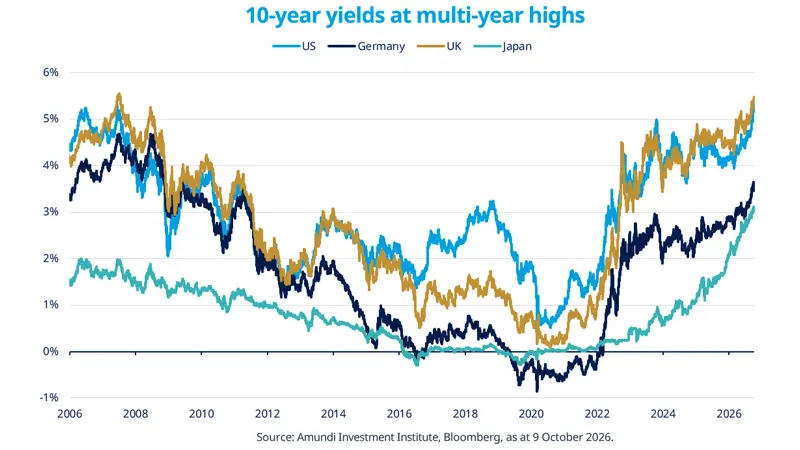
Long-term bond yields remain near multi-year highs across major countries, alongside increased volatility.
The move reflects a combination of forces: persistent inflation in several major economies, monetary policy uncertainty, concerns about government finances, and geopolitical tensions affecting energy prices.
For investors, the key implication is the need for a more flexible approach in fixed income and stronger diversification.
In this edition
Government bond yields across major developed economies have risen to levels not seen in years. The move has been accompanied by increased volatility, as markets have become more sensitive to macroeconomic data and policy expectations. US 10-year yields reached their highest level since 2002 before easing, as oil prices fell and following a well-received bond auction. Meanwhile, UK 10-year yields climbed to their highest level since the Global Financial Crisis, while German and Japanese yields have also risen sharply over the past few weeks. The move reflects several overlapping forces. Geopolitical tensions in the Middle East have kept oil prices elevated and added to inflationary pressure, while stronger US activity data and heavy corporate issuance linked to the AI build-out have pushed long-term yields higher. European bonds have also come under pressure from concerns over energy prices, inflation and a degree of fiscal and political uncertainty.
Key dates
India CPI, Japan PPI, US Small Business Optimism and Existing Home Sales |
China CPI, PPI, Export and Import, USA CPI and Real Earnings |
Japan Industrial Production and Machine Orders, USA Retail Sales and PPI, Euro Area Industrial Production |
Diversification does not guarantee a profit or protect against a loss.
Read more