
Capitalizing on aligned interests with banks to diversify re...
Discover an innovative case study on how a European insurer utilized fund structures to meet banks' liquidity needs, enhancing returns under Solvency...

In an environment characterised by interest rate volatility and episodic market stress, institutional investors increasingly seek solutions that enhance cash returns without compromising liquidity and capital preservation.
Our Smart Return Solutions are designed to capture a structural premium embedded in the bank funding market, a premium that is typically inaccessible through traditional treasury instruments such as cash and term deposits, while maintaining conservative risk parameters and high operational standards.

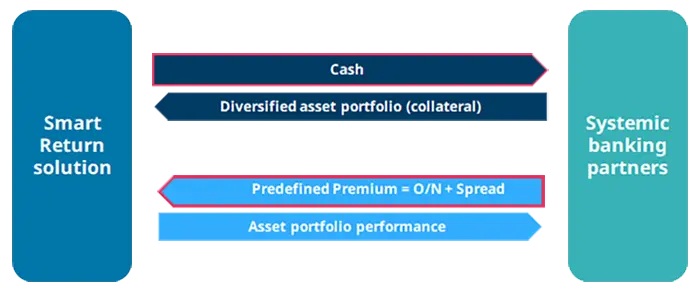
Our strategy uses a dual-transaction structure with systemic banks seeking alternative sources of funding, enabling predictable returns within a controlled counterparty framework.
Our vehicle buys a diversified pool of assets from the bank
The bank pays the vehicle a premium over the overnight rate (fixed upfront) in exchange for the assets' performance
Source: Amundi
Further details on the performance, investment process and structuring framework are available upon request and tailored to your needs.
AUM in Smart Return Solutions1
Track record delivering Smart Return solutions1
dedicated Portfolio Managers specialised in banking solutions
Smart Return solutions are designed to provide targeted, capital-efficient tools to help you navigate evolving market conditions.
Where can these solutions add value:

1.Amundi, as of 31/03/2026
A range of investment strategies combining ownership of asset baskets with fully collateralised Total Return Swaps (TRS) to deliver a money‑market‑style return (OIS + spread) with daily liquidity. The strategy is available through multiple investment vehicles, including commingled funds, dedicated funds and segregated mandates.
The vehicle purchases a basket of assets and uses a TRS with bank counterparties, so it receives Overnight Index Swap (OIS) plus a spread, while the counterparties receive the performance of the asset basket.
Economically no — the TRS neutralises equity performance so net equity exposure is close to zero; residual risk relates to counterparties and collateral.
A selected panel of investment banks. Exact counterparties and spreads differ by sub‑fund and are available on request.
Contracts include margining and collateral monetisation procedures; the manager may liquidate collateral and portfolio assets as required. Full details are set out in the contractual documents.
The solutions are not marketed as cash equivalents, though some investors may obtain such treatment from their auditors. Accounting classification depends on the investor’s rules.
This information is exclusively intended for “Professional” investors within the meaning Directive 2014/65/EU of the European Parliament and the Council of 15 Many 2014 on Markets in Financial Instruments (as amended) (MIFID II). It is not intended for the general public or for non-professional individual investors within the meaning of all local regulations, or for “US Persons”, as defined in the Securities and Exchange Commission’s “Regulation S” under the 1933 U.S. Securities Act. This non-contractual information does not under any circumstances constitute an offer to buy, a solicitation to sell, or advice to invest in financial instruments of Amundi or one of its affiliates (“Amundi”). Investing involves risks. The performance of the strategies is not guaranteed. Past performance does not predict future results. Investors may lose all or part of the capital originally invested. There is no guarantee that ESG considerations will enhance a strategy’s performance. The decision of investors to invest in the promoted strategies should take into account all characteristics of objectives of the strategies. All investors should seek professional advice prior to any investment decision, in order to determine the risks associated with the investment and its suitability. Amundi assumes no liability, either direct or indirect, resulting from the use of any of the information contained in this document, and shall not under any circumstances be held liable for any decisions taken on the basis of this information. This information may not be copied, reproduced, modified, translated or distributed, without the prior written approval of Amundi. This information is provided to you based on sources that Amundi considers to be reliable at the date of publication, and it may be modified at any time without prior notice.