
Summary
Highlights
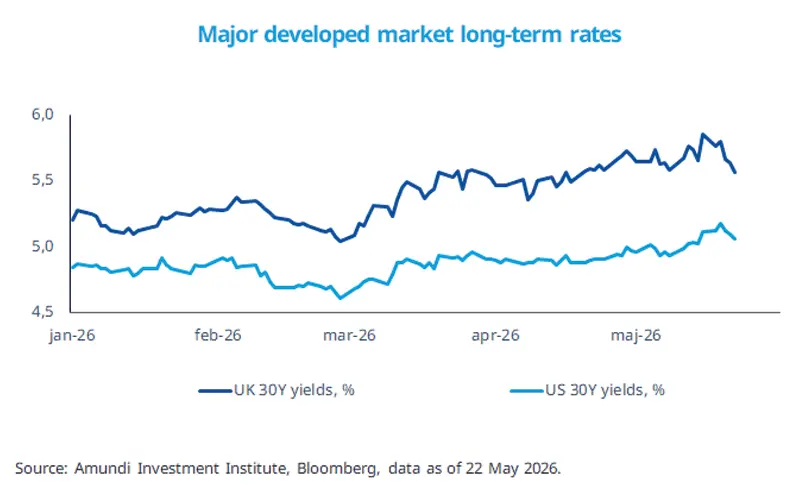
The US 30Y yields rose to 5.19%, the highest from 2007, while the 10Y moved above 4.5%. Yields across Europe and Japan also rose.
Pressure on global long-term bonds has been driven by uncertainty over inflation, monetary policy and fiscal spending.
All these factors support a more nuanced view of fixed income, with a close eye on the evolution of inflation and economic growth.
In this edition
Global yields have risen sharply this year as the Middle East crisis has led to increased price pressures. This, coupled with changing views on central bank policy and persistently high fiscal deficits (the excess of government expenditure over revenues), has pushed long-end yields higher — US 30Y yields have reached their highest levels since 2007–08. Looking ahead, strains on public finances and heavy bond supply could continue to put pressure on yields. On the inflation front, we think the pass-through of the energy shock to the broader economy requires closer scrutiny. The key risk is not only the surge in energy prices, but also how long they remain elevated and their second-round effects on the economy. This is, of course, affecting central bank policy in the near term.
Hence, although we are constructive on bonds, we prefer to express this view differently across the curve, favouring short- and medium-maturity bonds.
Key dates
US Conference Board Consumer Confidence |
Europe Economic Confidence, US Personal Spending, PCE price index and durable good orders |
Japan Retail Sales and Industrial Production, Brazil GDP Q1 |
Read more