
Summary
Highlights
Tensions flared in the Strait of Hormuz as Iran attacked passing ships. The US responded with airstrikes.
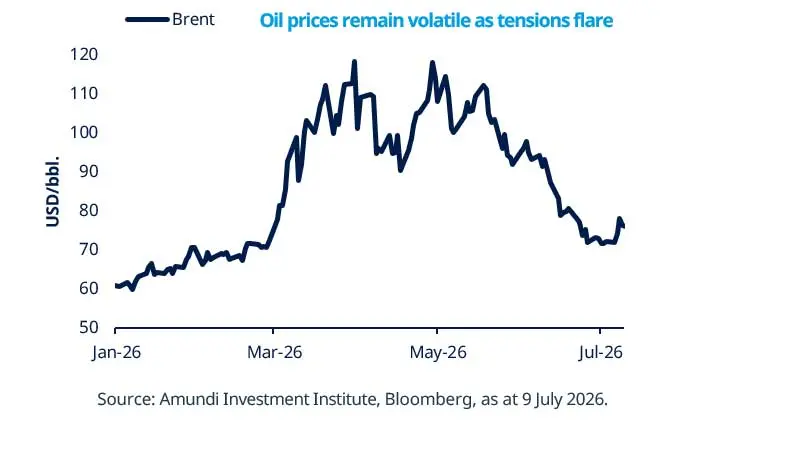
Recent tensions pushed Brent oil prices towards $80, interrupting the steep decline since mid-June.
The latest round of attacks has underscored the “fragile” nature of the de-escalation and sparked market volatility.
In this edition
Tensions in the Middle East have resurfaced, underscoring the “fragile” nature of the recent de-escalation. The latest round of attacks may be tied to Iran’s effort to preserve its leverage over the Strait of Hormuz. Meanwhile, Trump may become more willing to escalate tensions while oil prices remain subdued. Still, both sides have reasons to remain at the negotiation table, as the US approaches midterm elections and Iran would benefit from economic relief.
Although rerouting efforts have helped to normalise oil prices, recent tensions have emphasised that the ceasefire remains fragile, and traffic through the Strait of Hormuz is once again disrupted. Brent oil prices rose towards $80 a barrel, and we expect them to remain under pressure in the coming days.
The dynamics of oil prices and rerouting are important for their implications for inflation and central bank action. In the meantime, markets will remain volatile.
Key dates
14 Jul Japan industrial production; US CPI; China trade balance |
15 Jul China GDP, retail sales and industrial production; US PPI |
17 Jul Euro area inflation, US consumer sentiment |
Read more