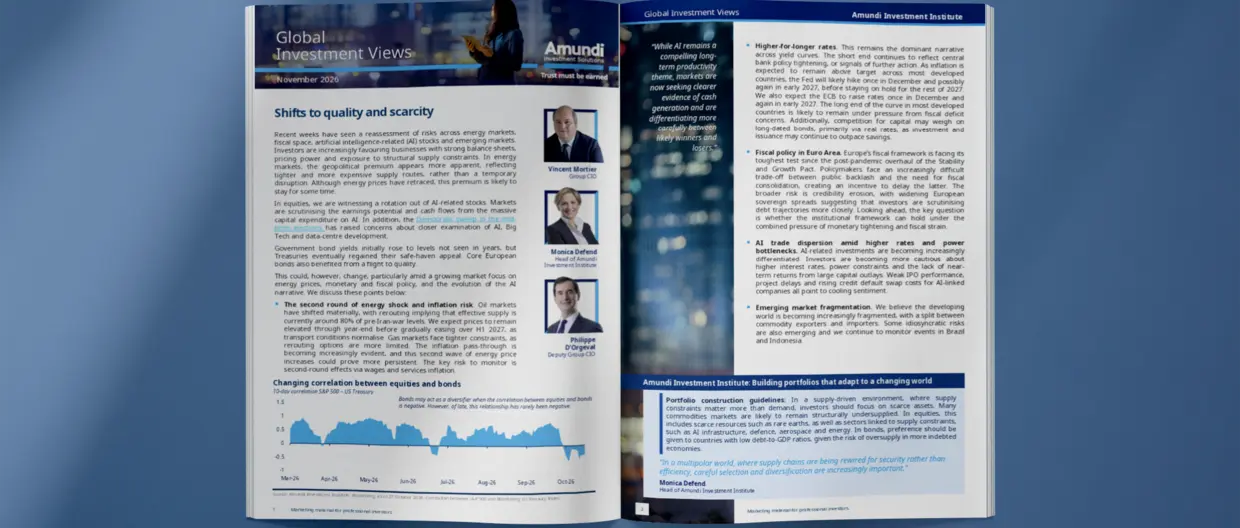
Shifts to quality and scarcity
Recent weeks have seen a reassessment of risks across energy markets, fiscal space, AI-related stocks and emerging markets. Investors are increasingly favouring businesses with strong balance sheets, pricing power and exposure to structural supply constraints. In energy, the geopolitical premium now looks more durable, reflecting tighter and more expensive supply routes rather than a temporary disruption.
In equities, we are seeing a rotation out of AI-related stocks, as markets question the returns on the massive AI capex cycle. The Democratic sweep in the mid-term elections has also increased scrutiny of Big Tech, AI and data-centre development.
Government bond yields initially rose to levels not seen in years, before Treasuries regained their safe-haven appeal. Core European bonds also benefited from a flight to quality.
Looking ahead, we focus on the following themes:
- Second-round energy shock and inflation risk. Higher energy prices could prove more persistent, especially if they feed into wages and services inflation.
- Higher-for-longer rates. The short end continues to reflect central bank tightening, while the long end remains under pressure from fiscal deficits and competition for capital.
- Fiscal policy in the Euro Area. Europe’s fiscal framework is under strain, and widening sovereign spreads show that investors are paying closer attention to debt trajectories.
- AI trade dispersion. Higher rates, power bottlenecks and weaker IPO performance are making AI investment more selective.
Emerging market fragmentation. The developing world is becoming more divided, with idiosyncratic risks still visible in Brazil and Indonesia.
In this environment, we maintain a mildly risk-on stance, with an emphasis on diversification, selectivity and portfolio construction.
Below we have outlined our views on asset classes in our current base-case scenario:
- In fixed income, we have slightly raised our constructive stance on Eurozone duration, favouring peripherals over core and retaining a steepening bias. We are also positive on the UK, while the US and Japan remain close to neutral. EM bonds remain attractive, and in credit we prefer Global IG, EU IG and higher-quality yield.
- In equities, we keep a balanced approach, combining defensive sectors with quality cyclicals and a focus on balance sheet strength. We remain positive on Europe and Japan, and constructive on EM.
- In multi-asset, we see rotation opportunities in favour of the US and Japan. We also remain positive on US and European duration, euro IG credit and EM debt. In FX, we have raised our tactical view on the BRL. Overall, we stay diversified through gold and bond hedges.
Continue reading the full document
Unless otherwise stated, all information contained in this document is from Amundi Asset Management S.A.S. and is as of 6 November 2026. Diversification does not guarantee a profit or protect against a loss. The views expressed regarding market and economic trends are those of the author and not necessarily Amundi Asset Management S.A.S. and are subject to change at any time based on market and other conditions, and there can be no assurance that countries, markets or sectors will perform as expected. These views should not be relied upon as investment advice, a security recommendation, or as an indication of trading for any Amundi product. This material does not constitute an offer or solicitation to buy or sell any security, fund units or services. Investment involves risks, including market, political, liquidity and currency risks. Past performance is not a guarantee or indicative of future results.
Date of first use: 6 November 2026
Doc ID: 6095290