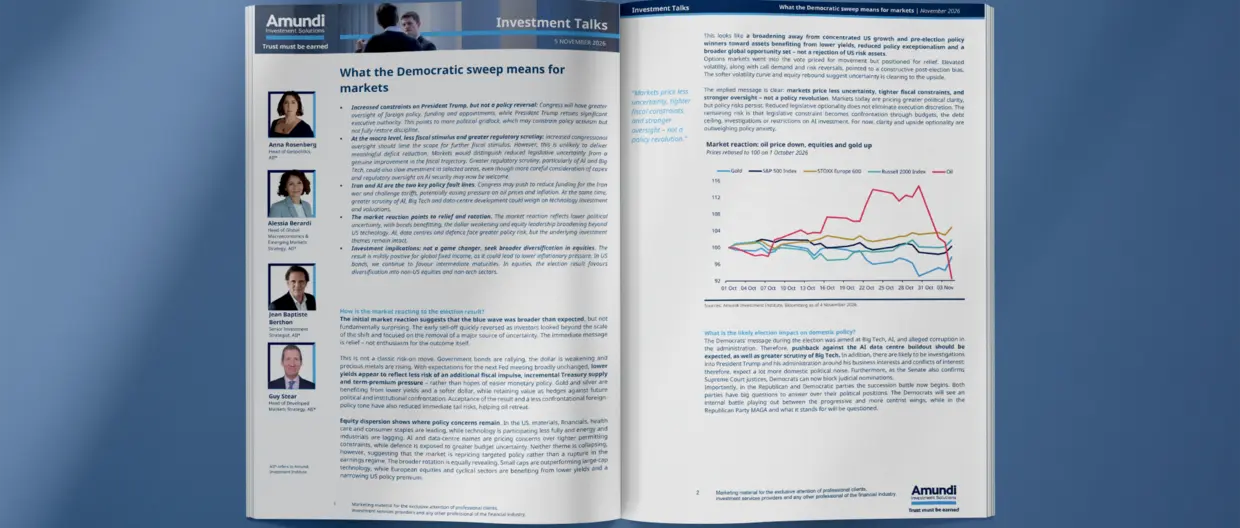
The so-called blue wave, which saw the Democrats taking control of both House of Representatives and Senate in the midterm elections, was broader than anticipated, though not fundamentally surprising.
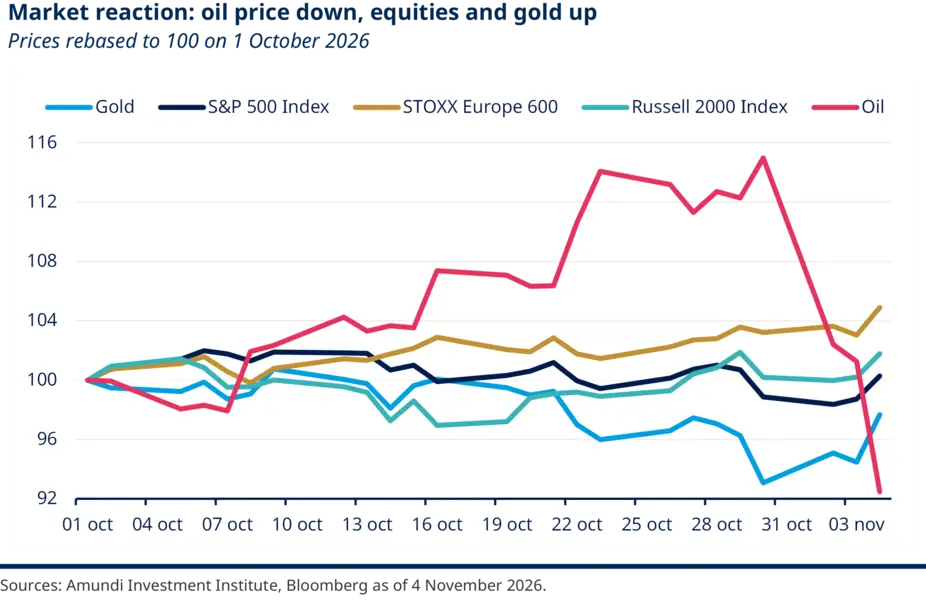
Markets responded positively, as the outcome removed a key source of event risk and reduced political uncertainty.
Democratic control of the Senate will allow the party to exercise greater scrutiny over President Trump’s foreign policy agenda. Nevertheless, the President retains considerable executive authority and can continue to pursue his objectives on foreign policy and tariffs.
Over the medium term, the election result could increase pressure on President Trump to de-escalate tensions with Iran, given Congress’s enhanced oversight of funding. Ukraine is likely to benefit from additional assistance and stronger security guarantees, while the outcome also improves the prospects for continued US commitment to NATO. However, no significant shift in US policy towards China should be expected.
Democratic priorities are likely to focus on redistribution, healthcare support and benefits for lower income households. These measures could provide some support to consumption at the margin, although their overall impact on inflation is expected to remain limited.
More broadly, many measures cannot be adopted unilaterally, particularly as President Trump has already indicated that he will exercise his veto power where necessary.
Although the fiscal stance could become more neutral or restrictive next year, we do not see a credible path towards a large-scale debt stabilisation programme.
What changes for markets?
The outcome is moderately positive for global fixed income, as tighter fiscal constraints could help contain inflationary pressures. In the United States, we maintain a broadly neutral stance on duration. We favour intermediate maturities while remaining more cautious at the long end of the yield curve.
For equities, the result supports greater diversification into non-US markets and sectors beyond technology, as market leadership is expected to broaden. AI and data centre investment could face tighter permitting requirements, while the defence sector may be exposed to greater budget uncertainty. Nevertheless, the underlying structural investment themes remain intact.
The implied message for investors is clear: markets are pricing in less political uncertainty, tighter fiscal constraints and stronger institutional oversight, rather than a policy revolution.
Discover how to invest with Amundi

AMUNDI FUNDS GLOBAL AGGREGATE BOND

AMUNDI FUNDS GLOBAL EQUITY
Continue reading the full article
Unless otherwise stated, all information contained in this document is from Amundi Asset Management S.A.S. and is as of 05/11/2026. Diversification does not guarantee a profit or protect against a loss. The views expressed regarding market and economic trends are those of the author and not necessarily Amundi Asset Management S.A.S. and are subject to change at any time based on market and other conditions, and there can be no assurance that countries, markets or sectors will perform as expected. These views should not be relied upon as investment advice, a security recommendation, or as an indication of trading for any Amundi product. This material does not constitute an offer or solicitation to buy or sell any security, fund units or services. Investment involves risks, including market, political, liquidity and currency risks. Past performance is not a guarantee or indicative of future results.
Date of first use: 05/11/2026.
Doc ID: 6091660.