
Key Takeaways
- European securitisation is regaining policy momentum as part of the European Union’s broader push to improve the efficiency of capital markets
- The proposed reforms aim to support a more efficient securitisation framework, enabling credit institutions to pool loans and convert them into securities, thereby expanding their capacity to originate new credit
- European securitisation presents attractive features for investors, including compelling spreads, low default rates, floating-rate exposure and portfolio diversification1 benefits
- Amundi’s European ABS team distinguish itself from peers, combining a long-standing market track record, broad multi-asset ABS exposure and disciplined, ESG-integrated investment expertise.
European securitisation is attracting growing interest and has moved to the centre of EU financial policy discussions in recent years. The current reform proposal, designed to review and potentially ease the capital requirements applying to banks and insurance companies, should be seen as the result of a debate shaped within the mature regulatory framework established after the global financial crisis.
The proposal sits at the intersection of several policy priorities, including support for credit intermediation in Europe’s bank-based financial system, stronger links between banks and capital markets, and the preservation of financial stability.
These considerations are further reinforced by the rising financing needs associated with the current geopolitical environment, which are increasing investment requirements in areas such as defence, energy transition and new technologies, with the aim of strengthening Europe’s competitiveness.
Within the broader context of the Savings and Investments Union (SIU)2, securitisation is increasingly being presented as a potential bridge between a financial system that still relies heavily on bank intermediation and the European Union’s ambition to deepen capital markets and mobilise private savings more effectively.
Securitisation allows credit institutions to pool illiquid financial assets - for example, corporate loans, mortgage loans, and consumer credit - and convert them into tradable securities that can be held or purchased by investors3. This is particularly relevant in Europe, where banks remain the main source of financing for households and businesses.
The economic logic is straightforward: by transferring part of the credit risk to investors, banks can manage regulatory constraints more efficiently and, in some circumstances, expand their capacity to originate new credit. The underlying policy hypothesis is that, if the framework is adjusted without weakening core safeguards, securitisation could play a more meaningful role in the European Union’s financial architecture, supporting credit intermediation and risk distribution while remaining compatible with financial stability.
The Letta and Draghi reports on EU reforms, published in 2024, also highlighted the revitalisation of the securitisation market as a way to enhance the lending capacity of European banks and support EU competitiveness4.
It is also worth noting that the European market remains significantly smaller than the US market. European securitisation, including the UK, is valued at approximately €1.29 trillion as of Q1 20265, compared with around €11.8 trillion in the US6.
Securitisation in a nutshell
Securitisation is a process in which an issuer, typically a bank, transfers a pool of loans or other receivables to an SPV (special purpose vehicle). The SPV is a separate legal entity established solely for securitisation and is usually structured to be bankruptcy remote from the originator. It then issues securities backed by the underlying assets and sells them to investors.
In this structure, investors’ returns depend primarily on the cash flows generated by the underlying assets - for example, mortgage loans - rather than on the creditworthiness of the institution that originated them.
Asset-backed securities, or ABS, are generally structured in tranches with different levels of seniority. This allows investors to choose the risk/return profile that best suits their objectives. Those seeking lower risk may invest in the senior tranches, which are repaid first, while investors willing to accept greater risk in exchange for potentially higher returns may invest in mezzanine or junior tranches, which absorb losses earlier in the structure.
The market is broadly split between two major segments: ABS and CLOs. The main difference between them lies in the type of underlying assets. In the case of ABS, the collateral typically consists of consumer loans - loans made to households. These can include, for example, mortgage loans, auto loans, credit card receivables or other forms of consumer credit.
By contrast, CLOs (Collateralised Loan Obligations) are backed by corporate loans. These are usually senior secured loans made to companies, often to borrowers in the sub-investment grade or high yield universe. Many of the companies included in CLOs are rated in the single-B range.
Simplified Securitisation Vehicle Structure

Source: Amundi. For illustration purpose only.
Key portfolio benefits for investors
Building on its structural characteristics, the European securitisation market offers several features that we consider relevant for investors:
- Attractive spreads: European securitisations can offer meaningful spread premium relative to similarly rated corporate bonds, including AAA-rated tranches which provide spreads versus swaps ranging from 40bps (prime Residential Mortgage-Backed Securities, or RMBS) up to 130bps (CLO primary)7. In our view, this differential reflects three main factors: (i) a smaller investor base, due to complexity and regulatory constraints; (ii) lower liquidity than in corporate bonds or credit indices; and (iii) optionality8, especially for CLOs. In addition, European securitisation spreads have historically shown moderate sensitivity to market shocks, and the recent regulatory changes are expected to provide long-term support.
- Low default rates: European securitisations, particularly senior tranches, have demonstrated low default rates over the past four decades. According to the European Commission’s latest market data and three regulatory proposals from June 2025, cumulative defaults remain below 0.1% for AAA-rated RMBS and are near zero across ABS and CLO senior tranches9.
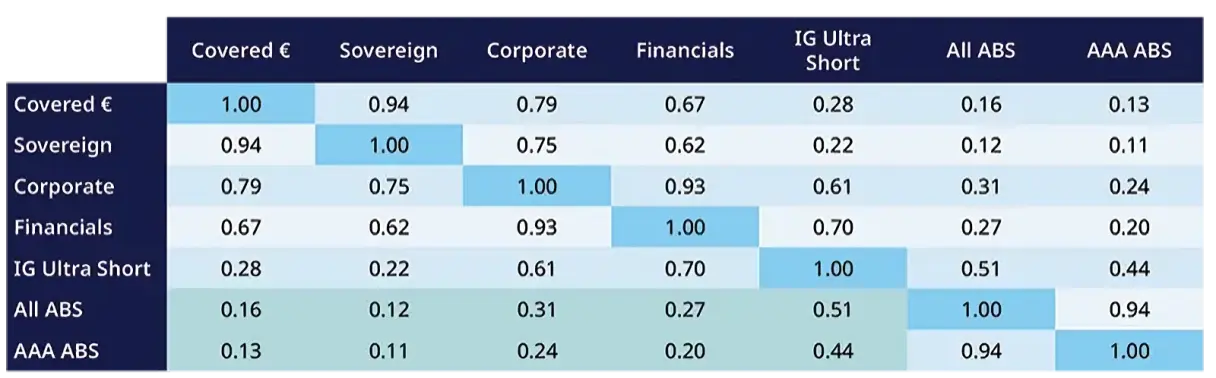
- Lower interest rate sensitivity: most securitisation tranches are floating rate instruments, with coupons typically linked to short term Euribor. This naturally reduces interest rate sensitivity and helps support portfolio stability in volatile rate environments. It has also contributed to the historically low correlation of ABS with short duration fixed income indices over the 2018–2025 period.
- Diversification10 beyond traditional bonds: securitisations provide exposure to assets with distinct risk drivers, helping to reduce correlation across credit segments and offering diversification beyond corporate or sovereign bond portfolios. As an illustration, according to historical data from 2018 to 2025, correlations between ABS (both all ABS and AAA ABS) and other short duration fixed income instruments remain relatively low. For example, all ABS range from approximately 0.16 to 0.51, while AAA ABS range from ~0.11 to 0.44.
- Liquidity: many securitisation investors typically have long-term mandates and can tolerate price volatility. During periods of market stress, they are generally less likely to engage in forced selling and may instead act opportunistically, buying securitisations at discounted prices, which can help support overall market liquidity.
Weekly Correlation Matrix: Bloomberg ABS Index vs. iBoxx 1-3y Indices from September 2018 to September 2025
Source: Bloomberg as of end of September 2025.
Expected timeline for implementation
In October 2025, the European Commission published a Delegated Regulation11 amending Solvency II12, with the aim of easing some of the longstanding regulatory barriers that currently constrain issuance and investment, thereby supporting additional lending to households and businesses.
To achieve this, the Commission has proposed targeted amendments to several key regulations: the Securitisation Regulation, the Capital Requirements Regulation (CRR)13 and Solvency II.
The legislative proposals are currently being considered under the ordinary legislative procedure and are subject to negotiations between the co-legislators. The proposed amendments to the CRR and the Securitisation Regulation will require trilogue14 negotiations and are therefore likely to take time to finalise.
As a result, the revised regulations are currently expected to enter into force in early 2027, alongside the Solvency II measures scheduled for the end of January 2027.
Expected legislative pathway from consultation to entry into force

Source: Amundi. November 2025. This timeline reflects Amundi's expectations regarding the legislative pathway as of November 2025. It is provided for illustrative purposes only. Dates and steps are subject to change based on official legislative developments and do not constitute legal, financial or regulatory advice. Amundi expressly disclaims any liability for reliance on this information.
What lies ahead – the expected impact of regulatory changes
Regardless of the exact timing of implementation, market participants may seek to increase exposure to European securitisations ahead of any potential spread compression resulting from the revised regulatory framework.
Compared with covered bonds or other secured instruments, securitisation offers an efficient way to raise capital and free up balance sheet capacity. In particular, we expect the ABS and RMBS segments to benefit from this dynamic, potentially unlocking significant issuance volumes and creating additional opportunities for capital deployment.
Overall, higher issuance volumes and broader investor participation should support greater market depth and liquidity, while also giving investors a wider range of issuers and transactions to choose from.
If the reform proposal succeeds in supporting credit intermediation without weakening financial stability, securitisation could gain a more central role in Europe’s financing architecture.
Why Amundi for European ABS
Amundi’s European ABS investment team differentiates itself from its peers through investment expertise, disciplined risk management and ESG integration15. Amundi ABS Responsible, its European open-ended ABS fund, has the longest track record in the market, having launched in 2006 and bringing more than 20 years of proven experience and expertise. The fund provides broad exposure to the European ABS universe, including RMBS, consumer credit, auto loans and CLOs.
Amundi ABS Responsible has experienced no loss related to a default since launch. Its approach is fundamental and conservative, combining top-down allocation with bottom-up selection, complemented by opportunistic investments when the risk/reward profile is attractive. The fund is characterised by continuous credit monitoring, tranche-by-tranche analysis and protection strategies designed to limit drawdowns, including CDS/iTraxx protection strategies16.
The strong investment experience of the Amundi ABS Responsible portfolio managers is further reinforced by a dedicated and experienced team of ABS analysts. ESG is also a key differentiator, with proprietary ESG scoring applied to issuers and collateral, as well as normative and sector exclusions.
Finally, Amundi is structured to meet client needs through dedicated support teams, integrated management, back-office and risk functions, and a common IT infrastructure, all supported by the company’s international presence across 35 countries. This allows Amundi to offer a high degree of customisation, responsiveness and economies of scale.
Discover our offer

Amundi ABS Responsible
Read our news and insights



[1] Diversification does not guarantee a profit or protect against a loss.
[2] The savings and investments union (SIU) is an initiative to improve how the EU's financial system channels investors’ savings into productive investments.
[3] Source: Council of the EU, Savings and investment union: Council agrees position on revitalising the EU’s securitisation market, press release 1123/25, 19 December 2025.
[4] Source: Council of the EU, Savings and investment union: Council agrees position on revitalising the EU’s securitisation market, press release 1123/25, 19 December 2025.
[5] Source: AFME Securitisation Report Q1 2026.
[6] Source: AFME Securitisation Report Q1 2026. It is worth noting that a significant proportion of the US market is concentrated in agency MBS, which are backed by US government agencies or government-sponsored enterprises (GSEs) such as Fannie Mae, Freddie Mac and Ginnie Mae.
[7] Association for Financial Markets in Europe, AFME Q2 2025 Securitisation Report, 30 September 2025
[8] Optionality refers to embedded features that can affect cash flows when borrowers or issuers choose to prepay, refinance or redeem securities earlier than expected.
[10] Diversification does not guarantee a profit or protect against a loss.
[11] A delegated regulation is an EU legal act used to supplement or amend non-essential parts of an existing EU law, without reopening the full legislative process.
[12] Directive (EU) 2009/138/EG “Solvency II” has formed the prudential framework for insurers across the European Union since 2016.
[13] The Capital Requirements Regulation (CRR) covers the prudential framework for credit institutions. The main changes focus on the regulatory capital calculation rules for securitization exposures.
[14] In the context of the European Union’s ordinary legislative procedure, a trilogue is an informal interinstitutional negotiation bringing together representatives of the European Parliament, the Council of the European Union and the European Commission.
[15]There is no guarantee that ESG considerations will improve the strategy or performance of the sub-fund. Please refer to Amundi's Responsible Investment Policy and Amundi's Sustainable Finance Disclosure Statement.
[16] Hedging strategies implemented through credit default swaps (CDS) and/or iTraxx indices, designed to reduce portfolio credit risk and limit potential drawdowns.
Unless otherwise stated, all information contained in this document is from Amundi Asset Management S.A.S. and is as of 01/09/2026. Diversification does not guarantee a profit or protect against a loss. The views expressed regarding market and economic trends are those of the author and not necessarily Amundi Asset Management S.A.S. and are subject to change at any time based on market and other conditions, and there can be no assurance that countries, markets or sectors will perform as expected. These views should not be relied upon as investment advice, a security recommendation, or as an indication of trading for any Amundi product. This material does not constitute an offer or solicitation to buy or sell any security, fund units or services. Investment involves risks, including market, political, liquidity and currency risks. Past performance is not a guarantee or indicative of future results.
Date of first use: 01/09/2026
Doc ID: 5806031