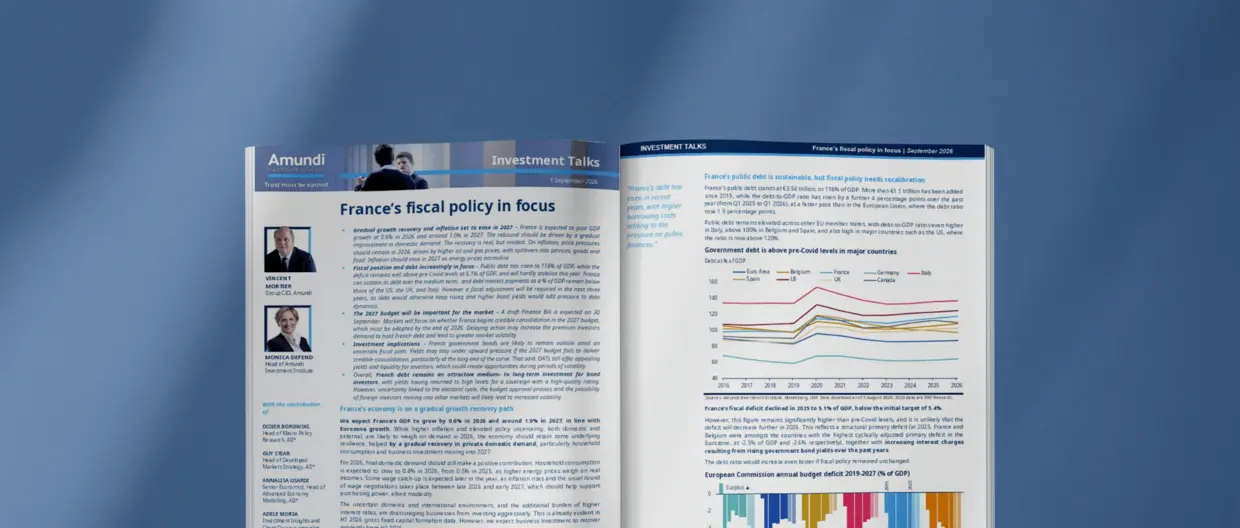
According to the Amundi Investment Institute, France’s economy is expected to achieve modest grow broadly in line with that of the euro area, with GDP projected to increase by around 0.6% in 2026 and 1.0% in 2027. While persistent inflationary pressures and political uncertainty are likely to constrain household and corporate spending, growth should remain relatively resilient, supported by a gradual recovery in private sector domestic demand.
A sustained reduction in the primary deficit will be essential to place public finances on a more sustainable long-term footing. Public debt has increased in recent years, although France’s debt-to-GDP ratio remains below that of some other major developed economies, including Italy and the United States. Long-dated French government bond yields, or OATs, recently reached their highest levels since 2008, partly reflecting a broader repricing across fixed income markets over the summer. The increase in the risk premium demanded by investors appears to reflect uncertainty surrounding the future path of the budget deficit, as well as the direction of fiscal policy over the next five years.
The 2027 budget, which must be adopted by the end of 2026, will be of central importance. Its preparation is likely to be made more challenging by the political calendar, with presidential elections followed by legislative elections (unless the National Assembly is dissolved beforehand) scheduled for the second quarter of 2027.
Nevertheless, France retains a number of characteristics that support its appeal to medium- to long-term bond investors. It remains a large, resilient and highly liquid sovereign issuer. Its government bonds benefited from a prolonged period of exceptionally low funding costs and continue to have a strong credit profile1. This is underpinned by the scale and diversification of the French economy, as well as the strength of its institutional framework.
The country’s creditworthiness is further supported by the depth and liquidity of its government bond market. The OAT market is one of the largest and most actively traded euro-denominated sovereign markets, supported by a broad and well-established domestic and international investor base. French government bonds account for more than 30% of the euro area’s highest quality sovereign debt universe. In addition, the relatively long average maturity of outstanding debt helps to contain near term refinancing requirements, while interest rate exposure is actively managed.
French government bonds therefore remain an attractive medium- to long-term investment for bond investors, offering relatively high yields for a sovereign issuer with a strong credit profile. However, uncertainty surrounding the electoral cycle, the budget approval process and potential shifts in global investor allocations could contribute to bouts of heightened volatility.
Read the latest Investment Talks to gain a full understanding of the Amundi Investment Institute’s views on French economy and potential investment implications.
Continue reading the full article
Latest publications



1. France is currently rated A+ with a stable outlook by Fitch (confirmed as of 28 August 2026), and Aa3 with a negative outlook by Moody’s.
Unless otherwise stated, all information contained in this document is from Amundi Asset Management S.A.S. and is as of 01/09/2026. Diversification does not guarantee a profit or protect against a loss. The views expressed regarding market and economic trends are those of the author and not necessarily Amundi Asset Management S.A.S. and are subject to change at any time based on market and other conditions, and there can be no assurance that countries, markets or sectors will perform as expected. These views should not be relied upon as investment advice, a security recommendation, or as an indication of trading for any Amundi product. This material does not constitute an offer or solicitation to buy or sell any security, fund units or services. Investment involves risks, including market, political, liquidity and currency risks. Past performance is not a guarantee or indicative of future results.
Date of first use: 01/09/2026
Doc ID: 5886921