Convictions
Back real assets in an inflationary environment
Support your portfolios against inflation with private markets

In a fragmented environment, greater emphasis should be placed on the real economy through private markets, as inflation increases the risk of traditional negative correlations weakening. Demand remains strong in areas linked to AI and the energy transition, such as data centres and infrastructure, but limited supply requires selectivity.
To seize opportunities in this era of fragmentation, we think that diversification* will need to extend beyond traditional approaches. Over time, market behaviour has shown the limitations of relying solely on conventional asset allocation to achieve truly effective portfolio diversification*.

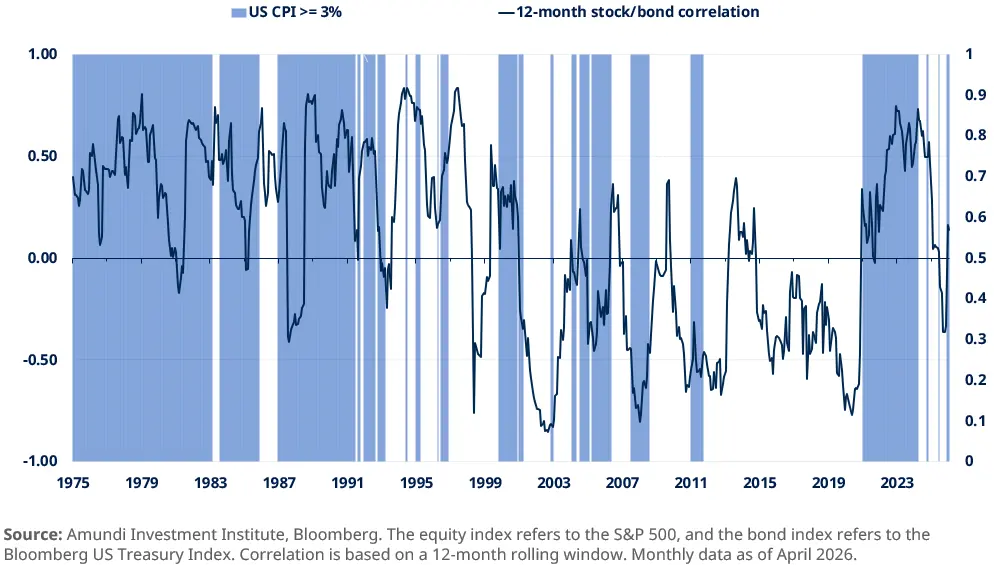
Private markets, namely infrastructure, private equity, private debt, and real estate, may offer a compelling solution, with distinct correlation patterns and improved risk-adjusted returns. They complement the traditional 60/40 equity/fixed income allocation, which is based on the historically negative relationship between equities and bonds. Over the past forty years, the correlation between these two asset classes has risen materially, and it is likely to strengthen further in the current inflationary scenario. Indeed, inflationary shocks push yields higher at a time when risk assets are under pressure, turning the bond/equity correlation positive and reinforcing the case for broader diversification*.
When US inflation stays above 3%, equity and bond correlation turn positive, and bonds tend to be a less reliable hedge
In infrastructure, demand is robust, but constrained supply calls for selectivity. Power and grid, AI, energy transition and inflation protection remain the key themes. Beyond crowded Tier 1 assets, execution and stock selection are essential.
In private equity, confidence is coming back after disruptions in the first part of the year. M&A and exits are picking up, supported by AI-related capex and the fading fog of war. The focus is still on durable value creation, with limited room for multiple expansion.
In private debt, concerns around liquid-sensitive vehicles are likely to persist. Differentiation across the broader private debt universe is increasing as spreads widen slightly and some defaults emerge. Deal flow stays supportive, although competition is intensifying in plain-vanilla lending1.
Finally, the recovery in real estate remains uneven: quality logistics, data centres and residential are improving, while offices continue to face pressure. Even so, stabilising rates are improving pricing visibility.
Private assets provide protection against inflation
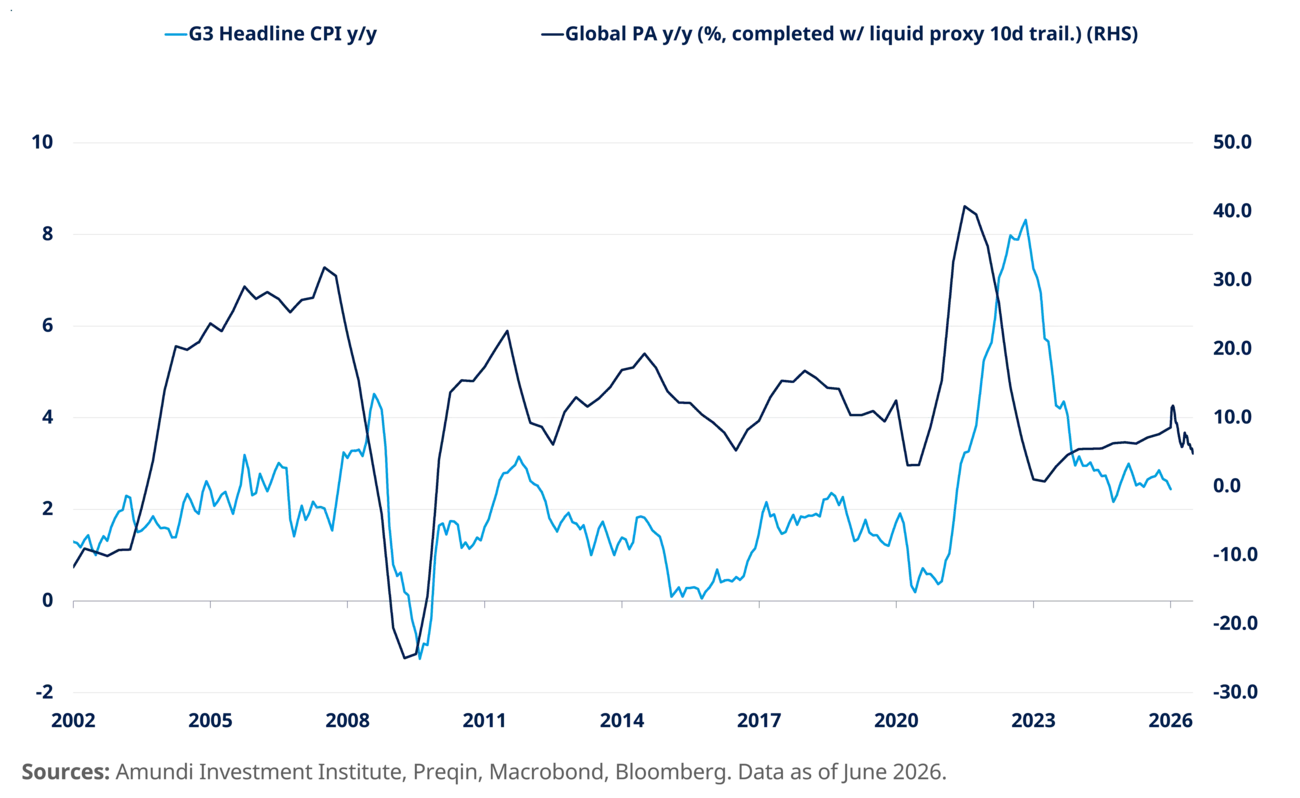
| Infrastructure | Strong demand, but constrained supply calls for selectivity |
| Private equity | Confidence is regaining momentum after H1 disruptions |
| Private debt | Moving towards the mid-cycle phase of credit |
| Real estate | Continued uneven progress |



Source: Amundi Investment Institute Mid-Year Outlook 2026, “Power of endurance”, June 2026.
* Diversification does not guarantee a profit or protect against a loss.
Views and opinions are as of end June 2026 and are subject to change without prior notice
1 Simple, standardised lending transactions with limited structural complexity.
Marketing material for professional investors only
Unless otherwise stated, all information contained in this document is from Amundi Asset Management S.A.S. and is as of 20 July 2026. Diversification does not guarantee a profit or protect against a loss. The views expressed regarding market and economic trends are those of the author and not necessarily Amundi Asset Management S.A.S. and are subject to change at any time based on market and other conditions, and there can be no assurance that countries, markets or sectors will perform as expected. These views should not be relied upon as investment advice, a security recommendation, or as an indication of trading for any Amundi product. This material does not constitute an offer or solicitation to buy or sell any security, fund units or services. Investment involves risks, including market, political, liquidity and currency risks. Past performance is not a guarantee or indicative of future results.
Date of first use: 20 July 2026
Doc ID: 5728517