Convictions
Fixed income: Adjust for the yield reset
Focus on flexibility and carry in an uncertain environment

Higher yields have improved the case for bonds, but flexibility remains essential to capture income. High debt levels and uncertain policy paths make long-term sovereign bonds less attractive, while strong fundamentals make Euro IG and EM IG bonds particularly compelling, especially as they trade at a discount to their US counterparts.
In our view, the arrival of Kevin Warsh could signal the start of a new chapter for the Federal Reserve. Under his guidance, the central bank may explore reforms that could reshape not only the conduct of monetary policy, but also the Fed’s relationship with the Treasury.
Overall, with monetary policy now broadly back to neutral, the Fed is likely to stay on hold in the coming meetings. Nevertheless, the risk of rate hikes would increase if higher energy prices began to filter through to broader inflation and economic growth accelerates. The disinflationary trend is expected to reassert itself in 2027, which could pave the way for rate cuts next year.
Beyond near-term rate decisions, markets will also need to adapt to reading the Fed’s signals, given shorter statements and a growing reluctance to offer clear forward guidance. Deeper Fed reform is also possible, given Warsh’s interest in redefining the boundaries between monetary and fiscal policy, even if this might raise concerns around central bank independence.
This could have meaningful implications for financial markets. Independent monetary policy and fiscal discipline have long underpinned the US dollar’s role as the world’s reserve currency and US Treasuries as the pre-eminent safe haven asset. If markets begin to question that framework, investors could demand a higher premium for holding US sovereign assets. Long-dated bonds could then come under renewed pressure, further reinforcing the de-dollarisation trend already under way.
Europe and emerging markets should instead benefit from capital rotating away from dollar assets.
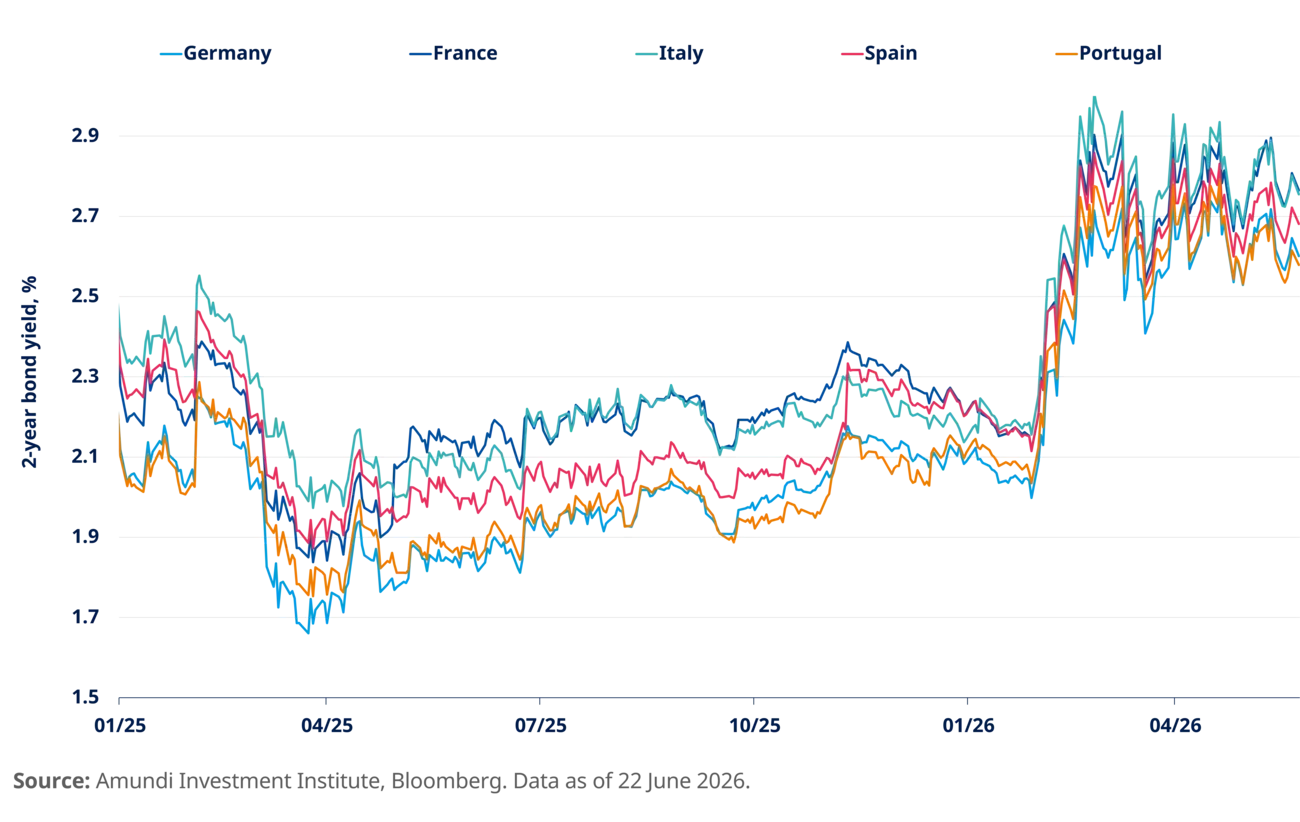
Historically appealing 2-year yields in EU
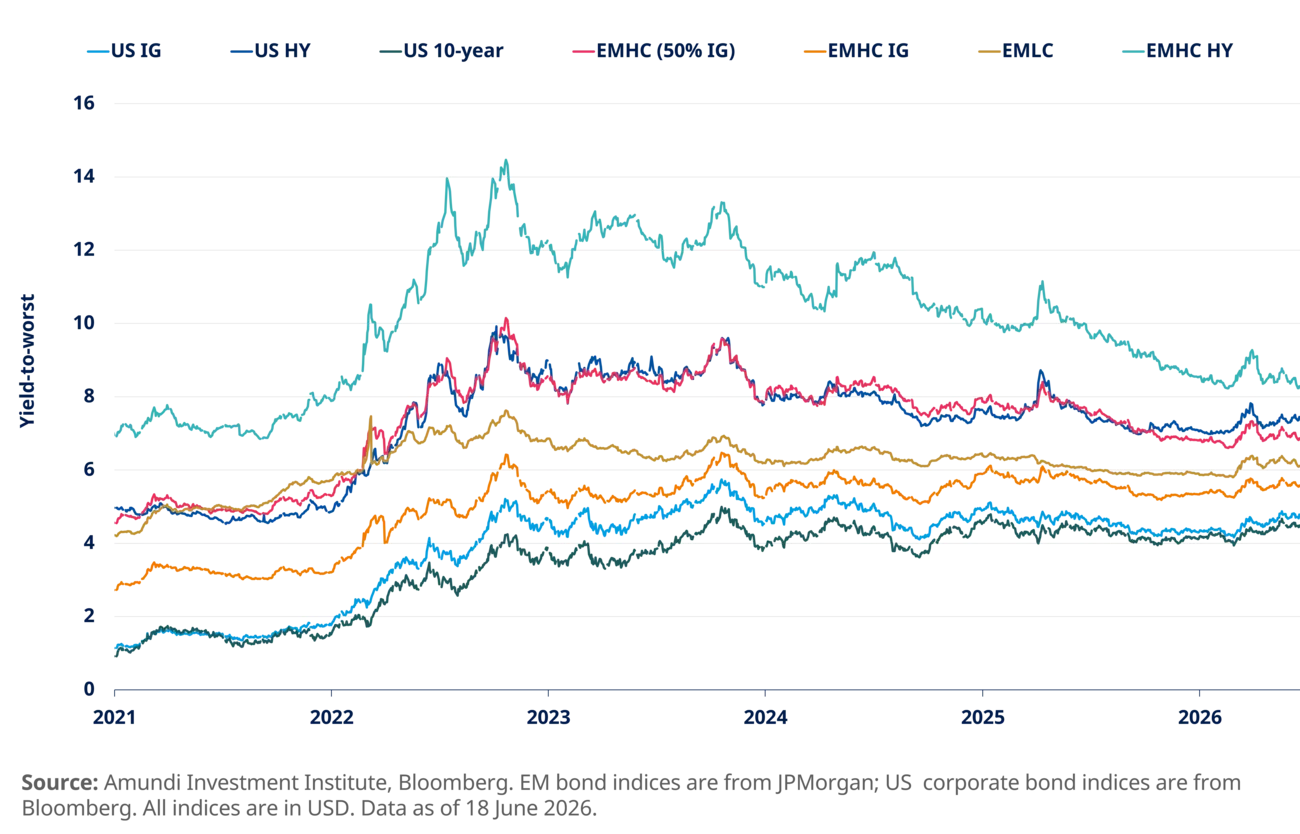
Attractive yields in absolute and relative terms
| EU duration | Good value in short-dated bonds (2-3Y) across core & peripheral Europe |
| UK duration | Valuations remain very attractive |
| EU IG credit | Convenient relative to the US, despite strong fundamentals |
| EM bonds hard currency (HC) | Supported by high carry; IG offer stability, while HY is appealing for income but more exposed to external shocks |
| EM bond local currency (LC) | Positive, with selectivity: favour countries in Latam and EMEA (Poland, Czech Republic) |
| EM FX vs USD | Cautiously positive, although geopolitical shocks and a hawkish Fed could remain key risks. |


Source: Amundi Investment Institute Mid-Year Outlook 2026, “Power of endurance”, June 2026.
* Diversification does not guarantee a profit or protect against a loss.
Views and opinions are as of end June 2026 and are subject to change without prior notice.
Unless otherwise stated, all information contained in this document is from Amundi Asset Management S.A.S. and is as of 20 July 2026. Diversification does not guarantee a profit or protect against a loss. The views expressed regarding market and economic trends are those of the author and not necessarily Amundi Asset Management S.A.S. and are subject to change at any time based on market and other conditions, and there can be no assurance that countries, markets or sectors will perform as expected. These views should not be relied upon as investment advice, a security recommendation, or as an indication of trading for any Amundi product. This material does not constitute an offer or solicitation to buy or sell any security, fund units or services. Investment involves risks, including market, political, liquidity and currency risks. Past performance is not a guarantee or indicative of future results.
Date of first use: 20 July 2026
Doc ID: 5728517