
Key takeaways
For investors seeking resilient income in a changing macro environment, EM corporate credit merits consideration within a broader EM allocation. It offers scale, breadth, and improving fundamentals, all of which support a constructive long-term investment case.
- Attractive income and risk-adjusted return potential: EM corporate credit offers compelling carry with lower duration risk versus the broader fixed Income universe. It also has historically strong risk-adjusted returns.
- Structural evolution and diversification*: the asset class has grown significantly and now provides broad exposure across countries, issuers, sectors, and themes.
- Improved fundamentals: stronger balance sheets, lower defaults, and more resilient funding structures are enhancing the asset class’s appeal.
Emerging market (EM) corporate credit can offer a differentiated source of income and attractive return potential within a broader EM allocation. At a time when the asset class benefits from strong fundamentals, a benign default backdrop, and lower sensitivity to interest rate volatility, the opportunity set is broad and diversified*. With around 60% of the universe rated investment grade1, and multiple sources of alpha from country, sector, and security selection, EM corporate credit combines quality with attractive risk-adjusted potential and can complement both EM sovereign debt and developed market credit in diversified* fixed income portfolios.
Attractive income and risk-adjusted return potential
With an average yield of 6.5%2, the asset class offers compelling carry with a lower duration than many other credit segments. This has historically contributed to superior risk-adjusted returns.
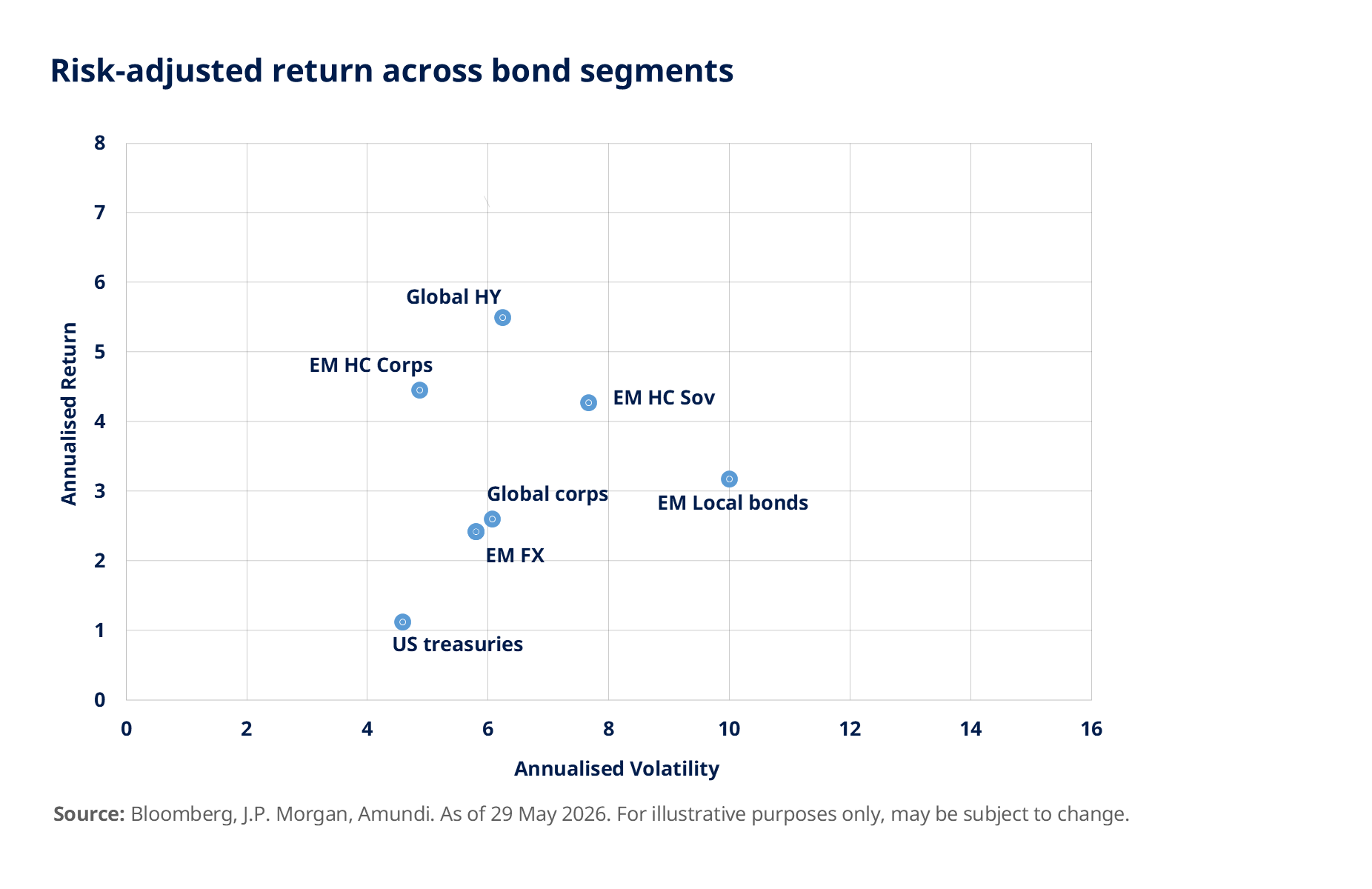
Although valuations are tighter than in the past, we do not believe this weakens the overall investment case. In fact, part of the tighter pricing reflects meaningful structural improvements within the asset class itself. EM corporates today generally have stronger business models, better governance, more disciplined risk management, and more diversified* funding sources than in the past. Importantly, EM corporate credit still appears attractive when assessed against its underlying credit fundamentals.
Valuations are also being supported by favourable market conditions. New issuance has been limited in some areas, while the asset class continues to benefit from relatively low investor ownership, strong diversification* characteristics, and competition from alternative financing sources such as domestic bond markets and bank lending. Together, these factors have helped keep demand for EM corporate credit firm.
An evolving asset class: strengthening fundamentals and policy frameworks
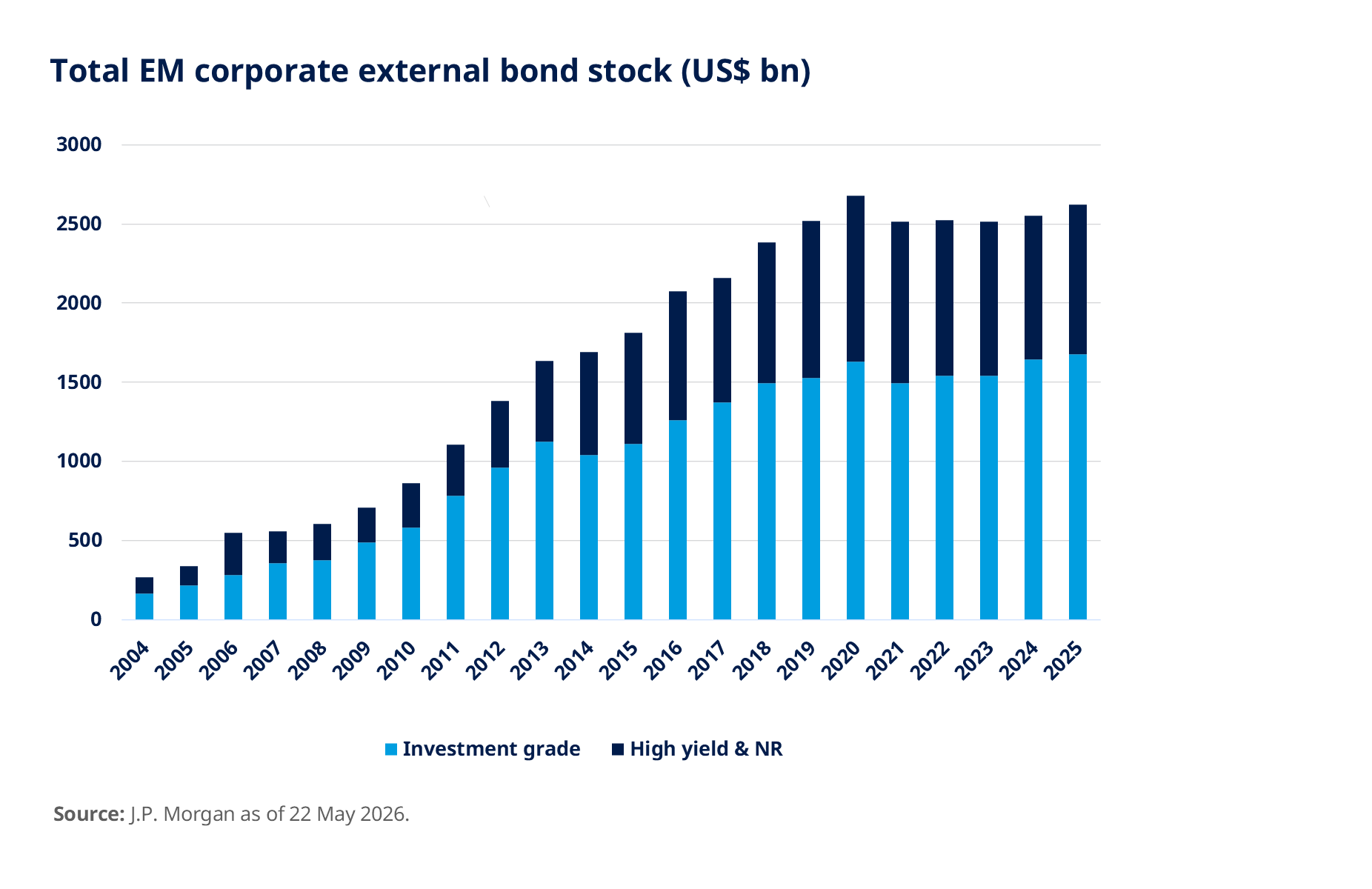
The asset class has also matured significantly over time. EM corporate credit is now larger, more diversified* and more investable, with a broader range of issuers, sectors and geographies. Over the past 15 years, the market has expanded markedly3, reflecting not only its scale but also a deeper structural transformation. Larger issuers improved operational resilience and stronger governance have all contributed to a more robust market structure.
This evolution is also visible in the fundamentals. Emerging markets are becoming more resilient and increasingly attractive on a relative value basis, supported by greater policy independence, ongoing reforms and improving economic discipline. While sovereign and geopolitical risks remain important, EM corporates generally still offer stronger fundamentals than many developed market peers, and we believe the EM–DM risk premium has room to tighten further.
Funding conditions have also improved. EM corporate issuers now have broader financing options, supported by domestic capital market reforms and more stable local currency or FX-hedged funding. This can help reduce borrowing costs and cash flow volatility, while lower funding pressure and reduced currency mismatch strengthen the overall risk profile of the asset class.
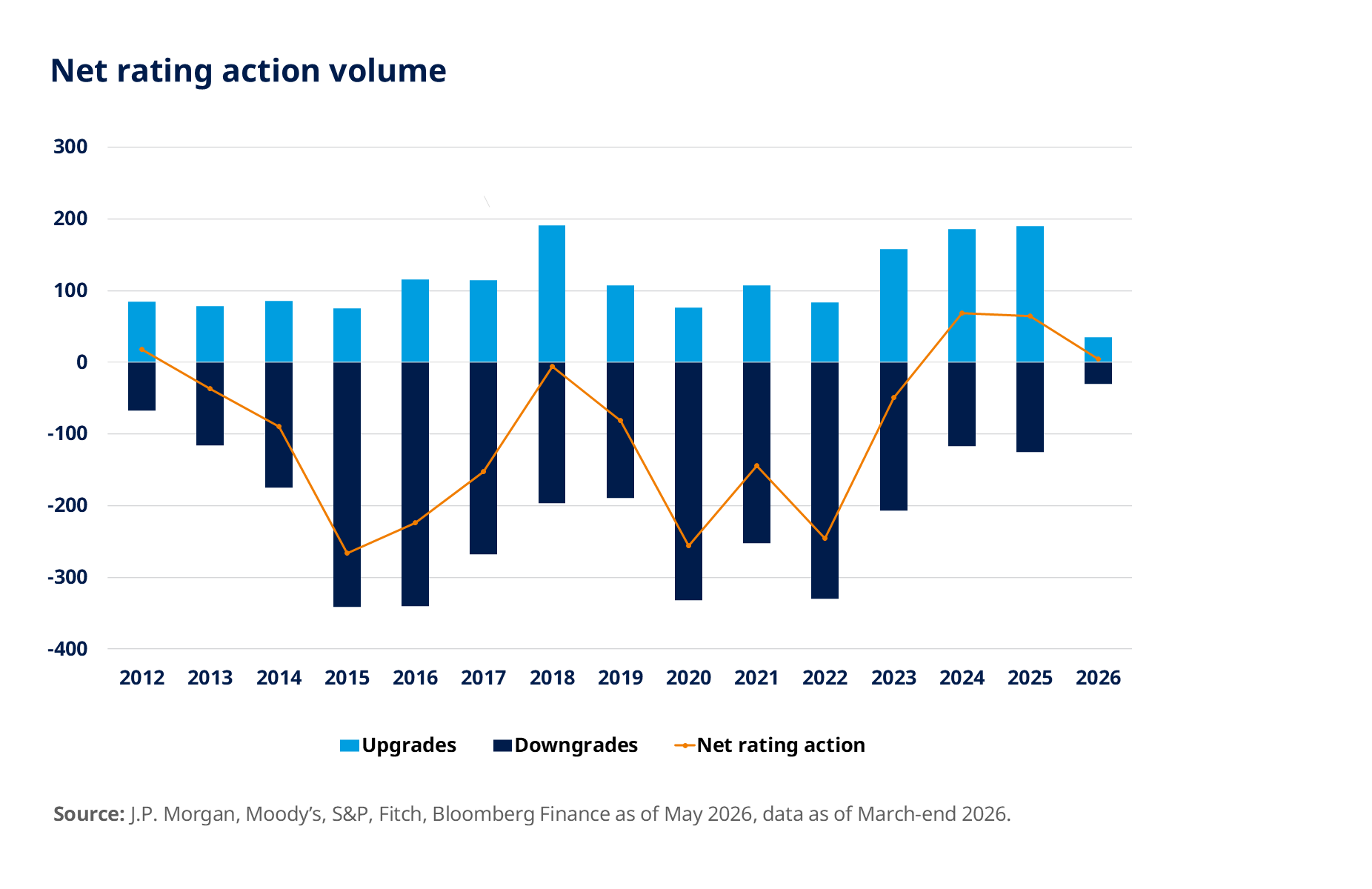
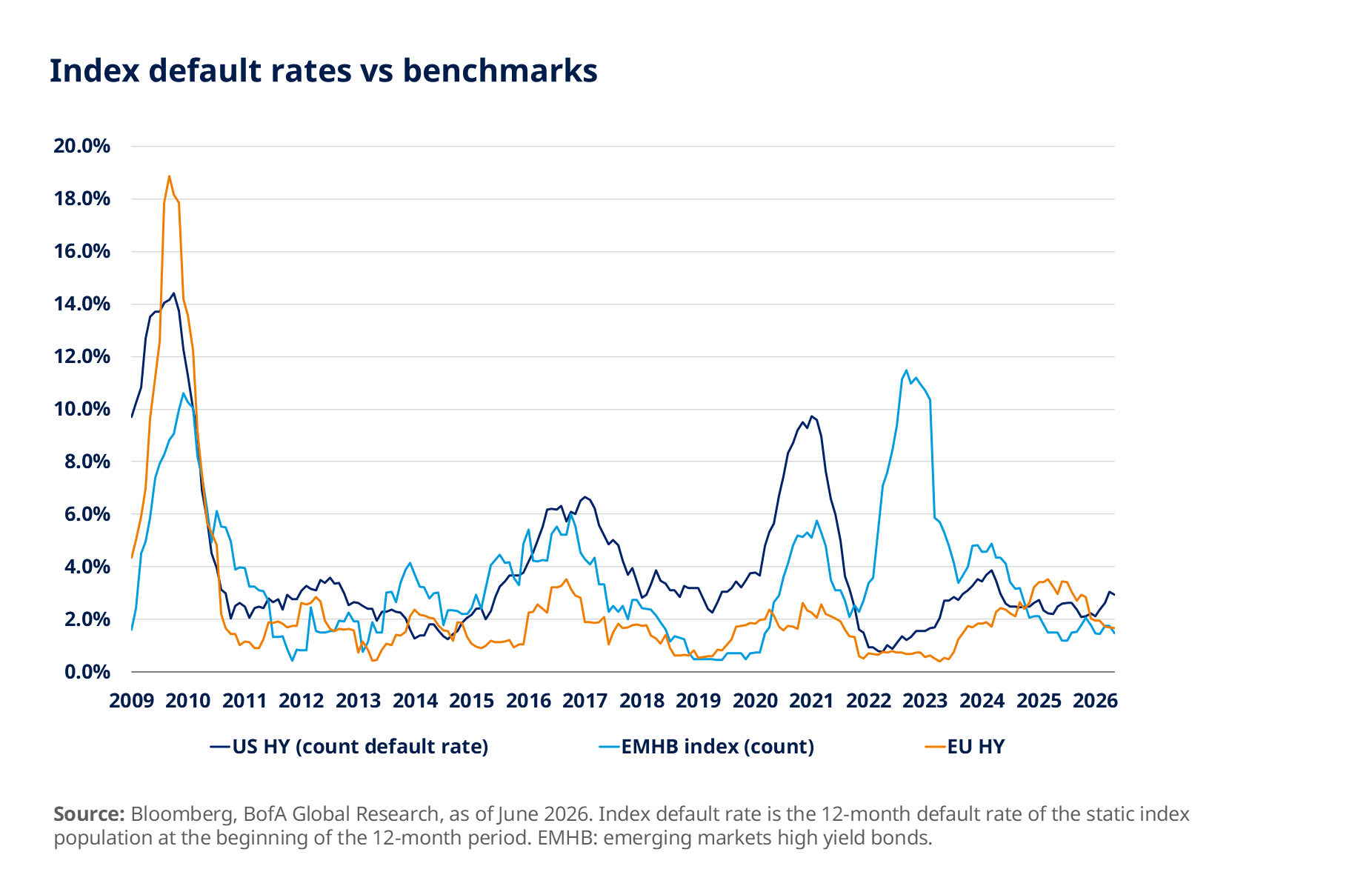
Balance sheets are also more resilient. The EM corporate universe is largely investment grade, while leverage remains lower and cash buffers higher than in many developed market peers. Improving fundamentals are further reflected in stronger rating trends and lower default rates, with upgrades outpacing downgrades in recent years and EM corporate high yield default rates falling below historical averages.
The breadth of the universe is another key advantage. The CEMBI Broad Diversified index, for example, spans hundreds of issuers, instruments and countries4, offering exposure to a wide range of secular themes — from technology in Asia to energy security and critical materials5.
For investors seeking resilient income in a changing macro environment, EM corporate credit deserves serious consideration. It offers scale, breadth and improving fundamentals, all of which support a constructive long-term investment case. Dispersion across markets, sectors and issuers creates significant scope for active security selection and relative value positioning. As such, EM corporate credit is particularly well suited to managers with strong fundamental research capabilities and the flexibility to navigate different phases of the cycle. Its differentiated exposure is not easily replicated through passive vehicles or ETFs, particularly where country and sector positioning are central to the investment process.
Why Amundi for EM debt
Amundi’s approach to EM debt is founded on deep expertise and extensive resources. With more than 20 years of active management experience in EM debt, and almost 15 years in EM corporate6, the team benefits from continuity and a long-standing understanding of the asset class and its driving forces, supported by a strong local presence across markets.
This local footprint enables portfolio managers to access specialist insights and detailed on-the-ground analysis. In addition, Amundi’s collaborative structure encourages close interaction across teams, facilitating the exchange of ideas on both macroeconomic and issuer-specific factors.
Proprietary credit models and in-house tools further strengthen the investment process, supporting effective risk monitoring and portfolio allocation. Amundi’s expertise in distressed EM debt adds another dimension, enabling the team to identify and capture risk-adjusted return opportunities in issuers under stress or in default.
See our EM debt offering

Amundi Funds Emerging Markets Bond

Amundi Funds Emerging Markets Blended Bond
Amundi Funds Emerging Markets Corporate Bond
Amundi Funds Emerging Markets Corporate High Yield Bond
Read our news and insights








* Diversification does not guarantee a profit or protect against a loss.
1Source: J.P. Morgan, as of June 2026.
2Source: J.P. Morgan, as of June 2026. Includes both investment grade and high yield.
3The size of the asset class has increased from 860bn USD to 2,621bn USD in 15 years. EM corporate high yield expanded by +339% to 946bn over the same period. EM corporates are now significantly larger than US HY (1.4tn USD) or EUR HY (0.5tn USD). Source: Amundi, J.P. Morgan, as of June 2026.
4The CEMBI Broad Diversified is J.P. Morgan’s benchmark index for USD-denominated emerging market corporate bonds, offering broad but diversified exposure across issuers, sectors and countries. It includes 740 issuers and 1847 instruments across 67 countries.
5E.g. lithium, copper, gold, rare earth, etc.
6Since April 2012, inception date of Amundi Funds Emerging Markets Corporate Bond.
Unless otherwise stated, all information contained in this document is from Amundi Asset Management S.A.S. and is as of 24 July 2026. Diversification does not guarantee a profit or protect against a loss. The views expressed regarding market and economic trends are those of the author and not necessarily Amundi Asset Management S.A.S. and are subject to change at any time based on market and other conditions, and there can be no assurance that countries, markets or sectors will perform as expected. These views should not be relied upon as investment advice, a security recommendation, or as an indication of trading for any Amundi product. This material does not constitute an offer or solicitation to buy or sell any security, fund units or services. Investment involves risks, including market, political, liquidity and currency risks. Past performance is not a guarantee or indicative of future results.
Date of first use: 24 July 2026
Doc ID: 5778534