
Key takeaways
- Fixed income remains attractive in today’s uncertain environment, offering compelling yields that can also act as a buffer against volatility.
- Opportunities remain broad, even within high quality segments, but flexibility and selectivity matter.
- Regional diversification* is becoming increasingly important, with opportunities across both developed and emerging markets.
While the global environment remains marked by elevated uncertainty, driven by geopolitical risks and upward pressure on prices, fixed income continues to stand out as an attractive asset class within a diversified* portfolio, offering both returns and greater resilience amid persistent turbulence.
Since central banks began withdrawing highly accommodative monetary policy in 2022, bonds have once again been offering attractive yields by historical standards. In some cases, these yields are even approaching equity-like return profiles, but with materially lower volatility.
Carry continues to support returns
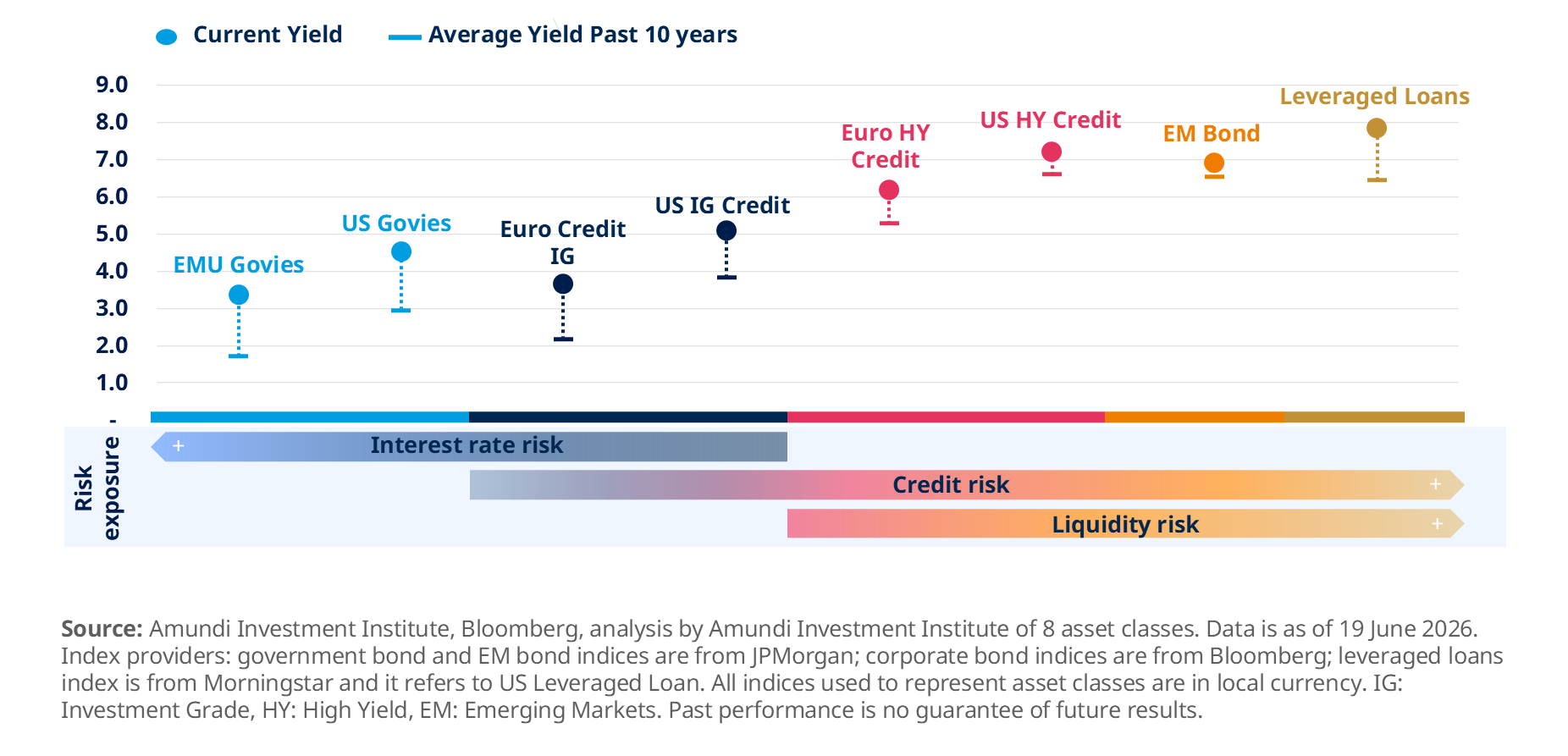
From a performance perspective, carry1 deserves particular attention in the current late-cycle environment. Although capital appreciation potential is limited as spreads remain compressed, current all-in yields remain meaningfully above historical averages. They can act both as a key driver of returns and as a cushion if spreads widen during periods of volatility, helping to mitigate downside risk.
We expect demand for bonds to remain strong in the coming months, as opportunities remain abundant. The yields offered even by high quality issuers allow investors to prioritise quality without compromising income, while focusing on issuers that can sustain attractive coupon income over the long term, supported by robust fundamentals.
Attractive yields compared to the past decade average
Finding value across the full fixed income spectrum
Diversification* is another key consideration. The breadth of the fixed income universe - spanning government bonds, investment grade credit, high yield, emerging market debt and securitised assets - together with its liquidity, allows managers to identify opportunities and generate alpha across a wide range of segments and regions, across both developed and emerging markets.
In the US, we remain neutral on duration, as robust labour data, elevated headline inflation and a relatively hawkish Federal Reserve are putting pressure on US rates, to levels that we find attractive in the middle part of the curve, and we continue to expect curve steepening. In credit, we are slightly positive on US investment grade, given its resilience to inflation shocks.
We see scope for Europe and emerging markets to benefit from investors seeking regional diversification*. In Europe, we see value in short-dated government bonds across both core and peripheral markets, while investment grade credit valuations convenient compared to other regions. Oil prices have not remained elevated long enough to materially weaken fundamentals, and Q1 earnings results were better than expected, highlighting corporate resilience.
For investors seeking additional income, subordinated financials could represent a compelling opportunity, providing exposure to investment grade issuers while offering enhanced yield potential.
Similarly, for investors looking beyond developed markets, we see strong potential in emerging markets. Many economies in the region have made significant progress over the past decade, particularly in reducing external vulnerabilities and improving macroeconomic policy design and implementation, which has also strengthened the credibility of local central banks. We continue to prefer issuers with stable and improving fundamentals, along with relatively attractive valuations in both hard and local currency.
In hard currency debt, we see value among sovereigns in Latin America and in select countries in Africa and emerging Europe, while we remain cautious on countries with tight spreads across Asia and the Middle East. Among corporates, we identify selective opportunities linked to the technology and green transition themes, alongside in oil and gas where dislocations may create value.
Looking at local currencies, we opt a selective, country-by-country approach, with a preference for commodity exporters and select frontier markets, particularly in Latin America, as well as countries with reform momentum and firmer domestic macro anchors.
Why Amundi for fixed income
At Amundi, we can count on deep expertise and a well-established investment process to capture opportunities across the broad fixed income universe, with €830 billion currently managed in active strategies2.
The teams’ investment philosophy is designed to deliver consistent returns by navigating credit cycles effectively and capitalising on market inefficiencies. This agile approach combines top-down and bottom-up analysis, enabling flexible adaptation to changing market conditions.
See our fixed income offering

Amundi Funds Global Aggregate Bond

Amundi Funds Global Corporate Bond

Amundi S.F. - Diversified Short-Term Bond Select

Amundi Funds Emerging Markets Bond

Amundi Funds US Bond
Read our news and insights








* Diversification does not guarantee a profit or protect against a loss.
1In fixed income, carry refers to the income an investor earns from holding a bond, primarily through coupon payments and, in some cases, the gradual convergence of the bond price towards par. It represents the return achieved before any contribution from changes in yields or spreads.
2Source: Amundi, as of 31 March 2026.
Unless otherwise stated, all information contained in this document is from Amundi Asset Management S.A.S. and is as of 28 July 2026. Diversification does not guarantee a profit or protect against a loss. The views expressed regarding market and economic trends are those of the author and not necessarily Amundi Asset Management S.A.S. and are subject to change at any time based on market and other conditions, and there can be no assurance that countries, markets or sectors will perform as expected. These views should not be relied upon as investment advice, a security recommendation, or as an indication of trading for any Amundi product. This material does not constitute an offer or solicitation to buy or sell any security, fund units or services. Investment involves risks, including market, political, liquidity and currency risks. Past performance is not a guarantee or indicative of future results.
Date of first use: 28 July 2026.
Doc ID: 5781434